
From Prompts to Agents: The Next Step for SMBs
In my last post, I outlined a practical evolution for how SMBs adopt AI. It starts simple and it should. Most teams begin with prompts, move into shared prompt libraries, then start embedding AI into workflows, and eventually build more structured operational systems.
The goal was never just to use AI more. It was to move from using AI to operating with AI.
Once you reach that point, there is a natural next step that many businesses are starting to explore.
That step is AI agents.
What Changes When You Introduce Agents
If your operational system defines how work should happen, agents are what begin to execute that work consistently.
At a high level, the progression is straightforward. Prompts handle individual tasks. Workflows structure those tasks. Systems make them repeatable. Agents begin to carry them out.
This is where things start to feel different. Work no longer depends entirely on someone remembering the next step or manually stitching things together. The process begins to move on its own.
It is also where things can go sideways if you move too fast.
Where Most SMBs Get It Wrong
Many teams try to jump straight to agents. They want something that runs operations, handles customers, or just takes care of things in the background.
But without structure underneath, all you are doing is automating inconsistency.
If your inputs are messy, your process is unclear, or your outputs are not defined, an agent will not fix that. It will scale it.
This is why so many early AI efforts stall. The technology works, but the process around it does not.
The Right Way to Think About Agents
Agents are not the starting point. They are the execution layer that sits on top of a well-defined system.
Before introducing agents, you need a clear understanding of how work flows through your business. That includes what triggers the work, how it moves from step to step, what good output looks like, and who is accountable at each stage.
When that foundation is in place, agents create leverage. Without it, they create noise.
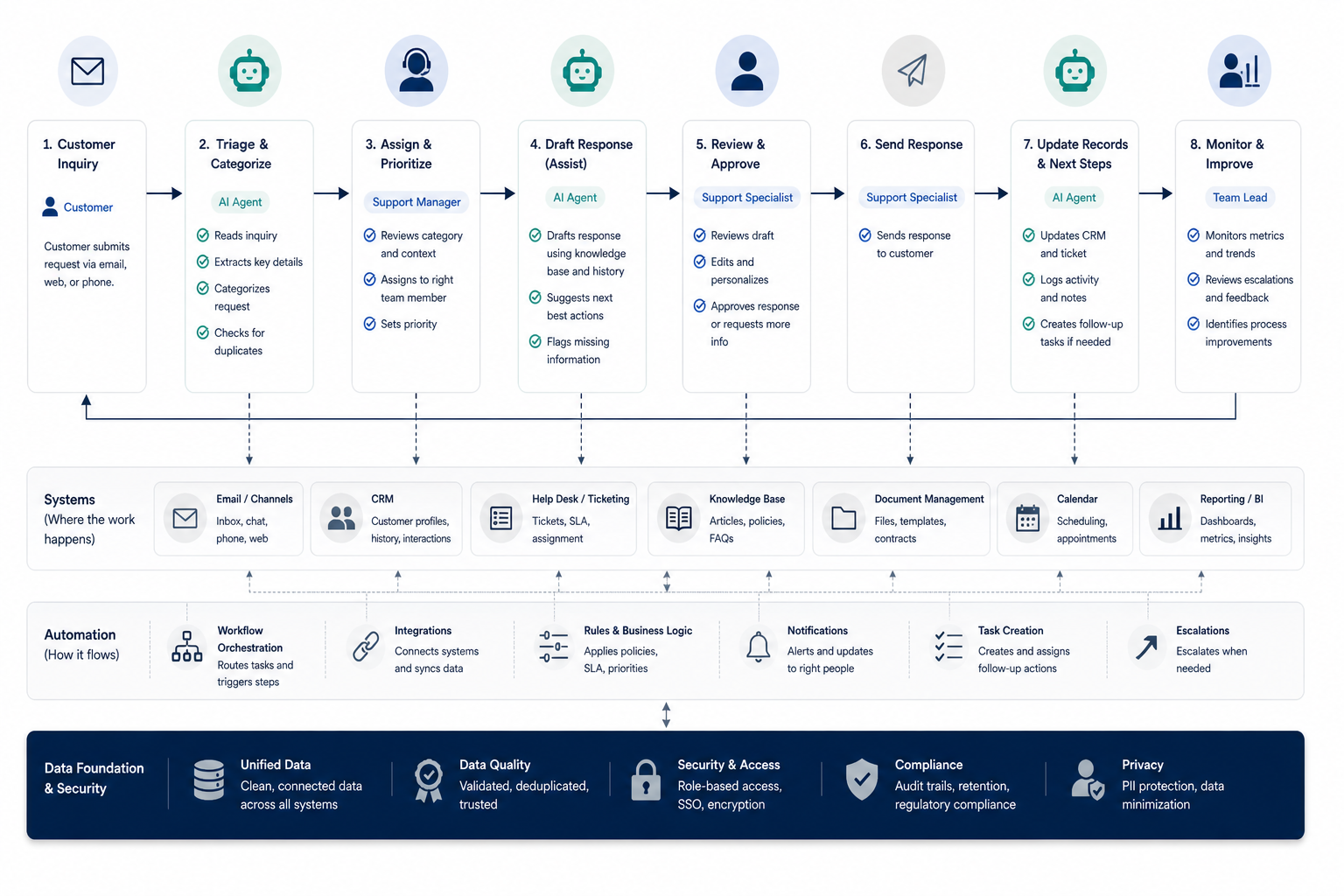
How Agents Actually Fit Into a Real Process
In practice, this does not mean replacing your process with AI. It means embedding agents into specific steps alongside people and systems.
A typical workflow still starts with a human or a structured intake. From there, an agent might classify the request or prepare a first draft. The work might then move to a person for review and decision-making. Once approved, systems and automation handle updates, record keeping, and follow-up.
Some steps are handled by people. Some by AI agents. Some by traditional automation.
Underneath all of it, your core systems, your data, and your security model are what keep everything aligned.
That is the real operating model.
AI is not the system. It operates within the system.
The Agent Maturity Curve
As SMBs evolve, agents tend to show up in stages.
Early on, agents assist. They prepare work, summarize information, and suggest next steps, but a person is still making the decision.
As confidence grows, agents begin to take action within defined guardrails. They route requests, update systems, and trigger workflows based on clear rules.
In more mature environments, some processes become largely autonomous, with humans stepping in only when something falls outside expected patterns.
Most SMBs should spend the majority of their time in the first two stages.
Why Smaller, Focused Agents Win
One of the most important design decisions is scope.
For SMBs, smaller, focused agents almost always outperform large, general-purpose ones. Trying to build a single agent that runs operations sounds appealing, but it quickly becomes difficult to manage, test, and trust.
What works better is aligning agents to specific steps in a process. One agent classifies incoming work. Another prepares a response. Another validates information. Another updates systems.
This mirrors how your business already operates. It also makes it much easier to improve things over time.
How You Know You Got It Right
A good agent does not feel like magic. It feels like something that used to take effort now just happens smoothly.
Your team understands what the agent does and what it does not do. The output is consistent enough to trust, but important decisions are still owned by people. Exceptions are surfaced instead of hidden, and the impact can be measured in terms of time saved, speed improved, or errors reduced.
If you cannot explain it simply or measure it clearly, it is not ready.
The Real Insight
Agents are getting a lot of attention right now, but they are not the breakthrough.
Operational discipline is the key.
Your last step was moving from prompts to systems. This step is about putting those systems into motion in a controlled, practical way.
The Simple Rule
If there is one takeaway, it is this:
Do not build agents to figure out your process. Build agents to run a process you already understand.
That is how SMBs move from experimenting with AI to actually improving how the business runs.
