
Decision models: the most useful AI of 2026 can't write a word
Last week I pointed an AI at my own inbox. Over 30 days, 749 emails had come in, about 24 a day and as many as 68 on a busy weekday. I asked the model five questions about every one of them: what kind of email is it, does it need a reply, is it junk, how urgent is it, does it involve money. It answered all 749 in 19 seconds. The bill was 3 cents.
The model is called Jev, from a company called TypeSafe AI that almost nobody had heard of in August. On September 15 it launched. Within two weeks, 35% of the paying teams on Vercel's AI Gateway had used it, the fastest adoption that platform has ever recorded, and those teams spent a combined 0.27% of the gateway's total on it. On October 9, Bloomberg reported that TypeSafe had raised about $870 million at a $7.5 billion valuation, 24 days after launch. The company says a third of the Fortune 500 is already using it.
All of that for a model that cannot write a sentence. Jev does not chat, summarize, draft or explain. It does one thing: you hand it some information and a short list of questions with fixed answers, and it picks. We think it is the most useful AI release of 2026 for the kind of businesses we work with, and this article explains why in plain language.
What a decision model is
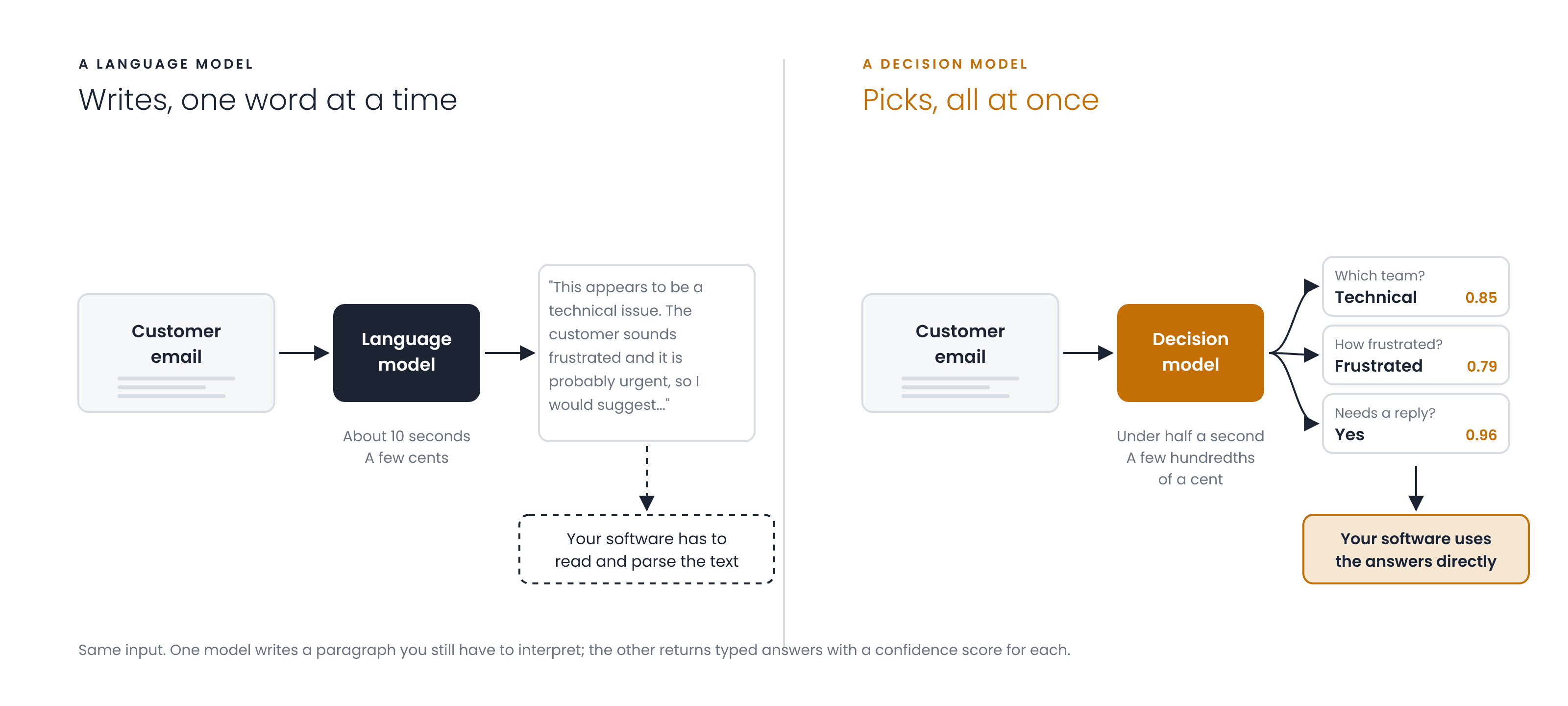
Every AI tool you have used in the last three years works the same way underneath. You type something, and the model writes back, one word at a time. ChatGPT, Claude, Gemini, Copilot: all of them are writers. That is why they are called language models.
Jev is not a writer. It is a picker. You give it a piece of information, say a customer email, and a few questions where you have already written the possible answers. Which team should handle this: billing, technical or sales? Is this urgent: yes or no? How frustrated is the customer, on a scale from calm to furious? Jev reads the email and answers every question at once, and attaches a number to each answer saying how confident it is. It returns the whole thing in a fraction of a second.
Three things follow from that design, and they matter more than they sound.
It cannot make things up. A writer can invent a fact or wander off the question. A picker can only choose from the answers you gave it. It can pick the wrong one, which we will come back to, but it cannot produce an answer that was not on the list.
It is very fast. A writer produces one word at a time, and a thoughtful answer might take ten seconds. Jev answers all of its questions in a single pass, typically in 70 to 500 milliseconds.
It is very cheap. Because it never writes anything, there is nothing to charge for on the way out. TypeSafe bills $0.042 per million tokens of input, roughly 750,000 words, and nothing for output. That is about 3,000 customer emails for four cents.
TypeSafe calls this a System One model, after the psychologist Daniel Kahneman's distinction between fast, intuitive judgment and slow, deliberate reasoning. Language models were built to do the slow kind well. Jev is built for the fast kind, which turns out to be most of the decisions a business actually makes.
The three kinds of question it can answer
Everything you can ask Jev fits one of three shapes.
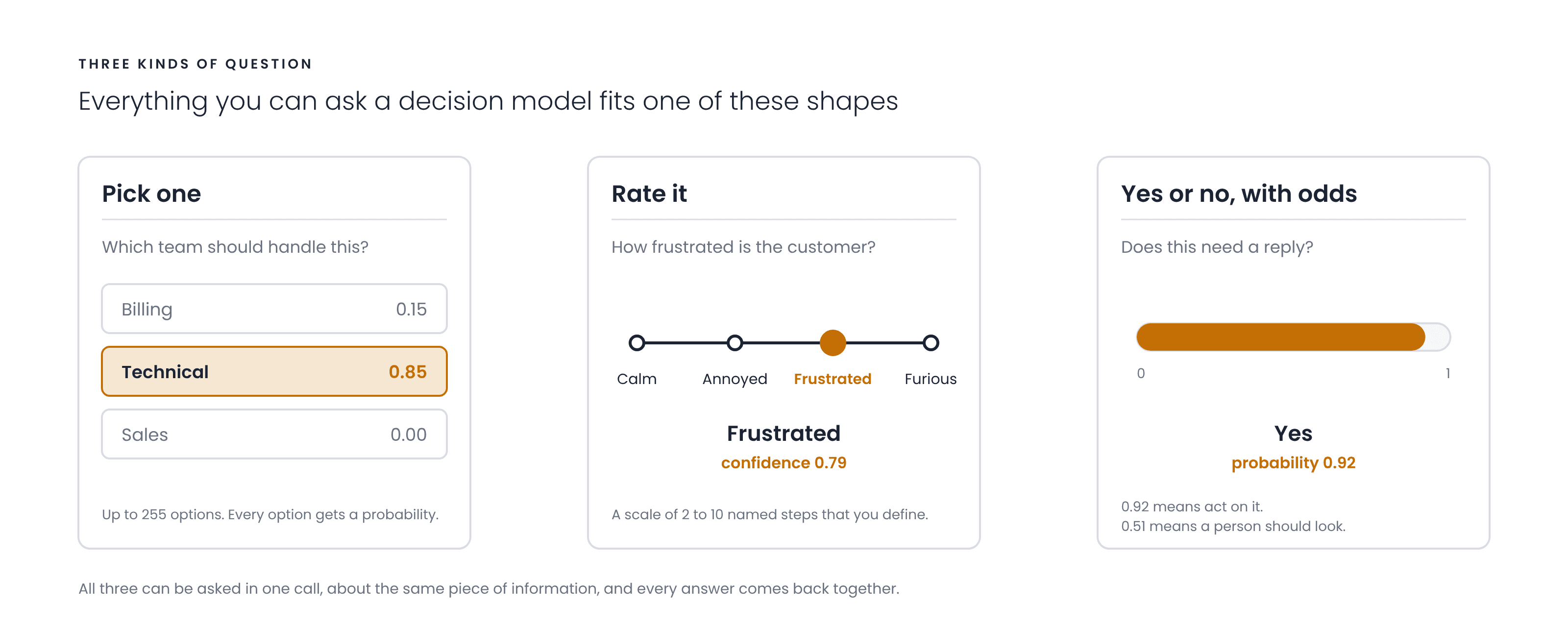
Pick one. You give it a list of options, up to 255 of them, and it picks the best fit. Which team should handle this ticket? What kind of email is this? Which of our 40 products is this review about?
Rate it. You give it a scale with named steps, and it places the input on that scale. How frustrated is this customer: calm, annoyed, angry, furious? How severe is this bug: cosmetic, inconvenient, blocking?
Yes or no, with odds. You state something and it tells you how likely it is to be true, from 0 to 1. Does this email need a reply? Is this invoice a duplicate? Is this lead worth a phone call? A 0.92 means act on it. A 0.51 means a person should look.
That last number is the part people underrate. A rule in your software is either on or off. A person scanning an inbox has a gut feeling they cannot write down. Jev gives you the gut feeling as a number, and TypeSafe trained it so that the number is honest: across a large batch of answers given at 80% confidence, about 80% are right. Calibration is a property of the batch, not a guarantee on any single answer, but it means you can set a threshold and trust it.
You can ask all three kinds of question in one call, about the same piece of information, and get every answer back together.
Why it is getting so much attention
The short version: it made a whole category of automation affordable overnight, and the industry noticed within days.
Start with the economics. TypeSafe's own benchmark puts Jev at roughly the same accuracy as a mid-tier language model on decision tasks, at about 75 times lower cost per decision and 25 times faster. Independent tests are less flattering on accuracy, which we cover below, but nobody disputes the cost and speed. A language model call for a routing decision costs a few cents and takes a few seconds. A Jev call costs a few hundredths of a cent and takes a few hundred milliseconds. When a decision has to run thousands of times a day, that is the difference between a project you approve and one you do not.
Then the adoption. The Vercel numbers above are the cleanest signal: a third of paying teams tried it in two weeks, for a rounding error of total spend. Demand was heavy enough that TypeSafe paused new signups for several days in late September to protect service for existing users. By the time they reopened, the funding round had leaked and the valuation story took over.
The third signal is the one that convinced us this is a category and not a product. Within three weeks of launch, OpenAI announced a Decisions API, Cloudflare shipped two open-weight decision models, Microsoft released Decision-1 on Azure, Perplexity and Amazon put out their own, and the open-source community produced more than a hundred imitations. Every major cloud now offers a decision model. That does not happen for a feature. It happens for a new layer of the stack.
The founder's background helped the story travel. Diogo Almeida led research at OpenAI that became part of ChatGPT, left two years ago, and built this in stealth. His pitch is that chat models were never the right tool for automating software, and that the industry spent three years trying to make a writer do a picker's job.
Where decisions hide in your business
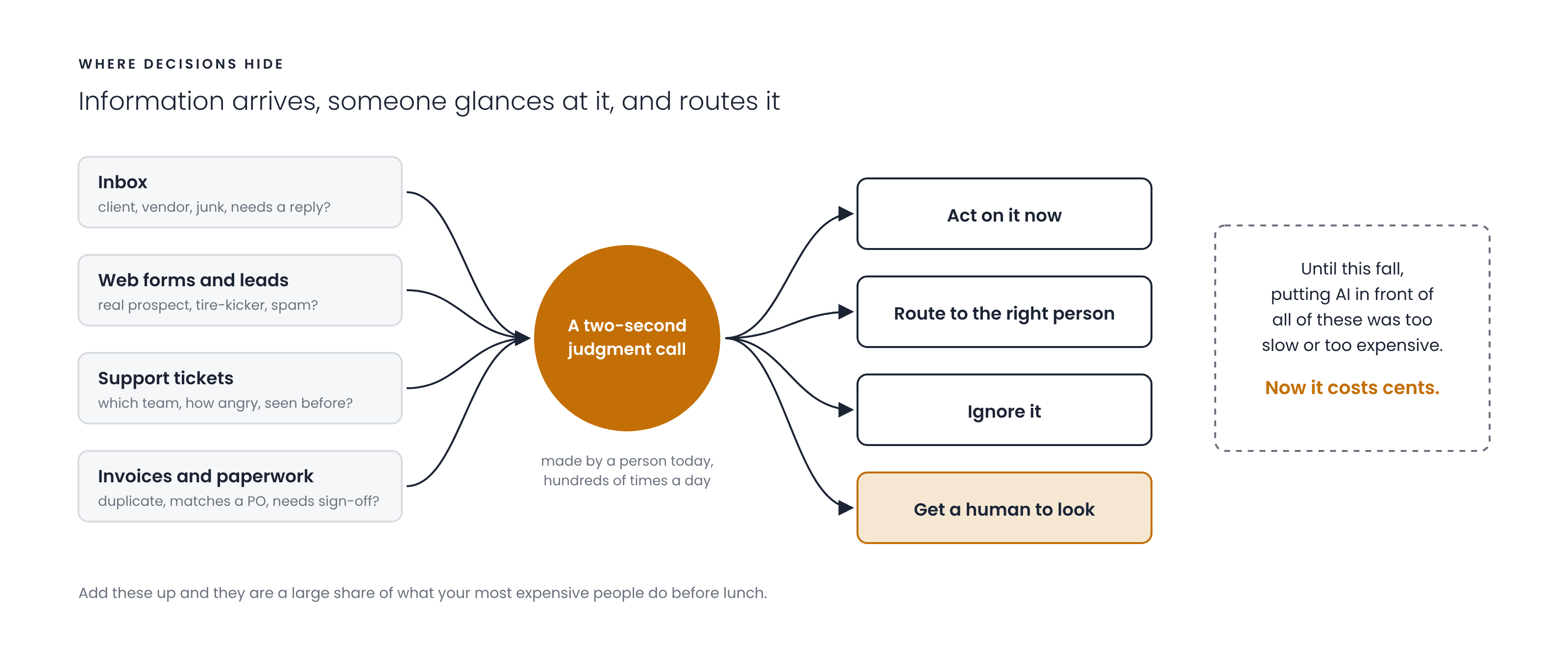
Your business does not run on paragraphs. It runs on hundreds of small judgment calls a day, most of them made by a person glancing at something and deciding where it goes. Nobody thinks of these as decisions because they take two seconds each. Add them up and they are a large share of what your most expensive people do before lunch.
Here is where they live in almost every company we have worked with.
The inbox. Every message that arrives gets a silent verdict: client, vendor, junk, newsletter, needs a reply today, can wait. Someone makes that call hundreds of times a day, and the cost of getting it wrong is a missed client or a late reply. This is the single easiest place to put a decision model, which is why every demo starts here.
Contact forms and inbound leads. A form submission is either a real prospect, a tire-kicker, a vendor pitching you, or spam. A decision model can score it the moment it lands, so the real ones get a call back in ten minutes instead of two days. One graphic design agency owner set this up the week Jev launched to sort her website inquiries by how likely they were to become paying work.
Support and service requests. Which team does this belong to? How angry is the customer? Is it the same problem three other people reported this week? These are routing and scoring questions, the exact shape Jev was built for, and they are usually handled today by a person reading every ticket.
Invoices, purchase orders and paperwork. Is this a duplicate? Does it match a PO we have? Does it need a manager's sign-off? Does it mention a price change? Most of this is a yes-or-no question with a document attached.
Anything that needs a human to look. This is the one most people miss. The highest-value decision in many workflows is not the sort itself but the flag: this one is unusual, get a person. A model that can say "I am only 55% sure" is worth more than one that is confidently wrong, because the uncertain ones are exactly the ones you want to see.
The pattern is the same every time. Somewhere in your operation, information arrives, a person glances at it and routes it, and the routing is the bottleneck. Until last month, putting AI in front of all of that was either too slow, too expensive, or both. Now it costs cents.
How to use it well
The early results show that Jev is not very good out of the box and very good when used the right way. Three habits make the difference, and they are habits, not technology.
Ask small questions, not big ones. An independent tester asked Jev a single question, "is this email phishing?", across 2,000 emails and got 62.6% right. A small language model got 81.3%. Then he broke the problem into five specific questions: does the link use a URL shortener, does the sender claim to be a company while using a free email address, and so on. Jev's accuracy went to 95.0%, and the cost was four cents per thousand emails. The lesson generalizes. A decision model is a specialist at narrow judgments. Give it narrow judgments. Since you pay nothing for its answers, asking ten questions costs the same as asking one.
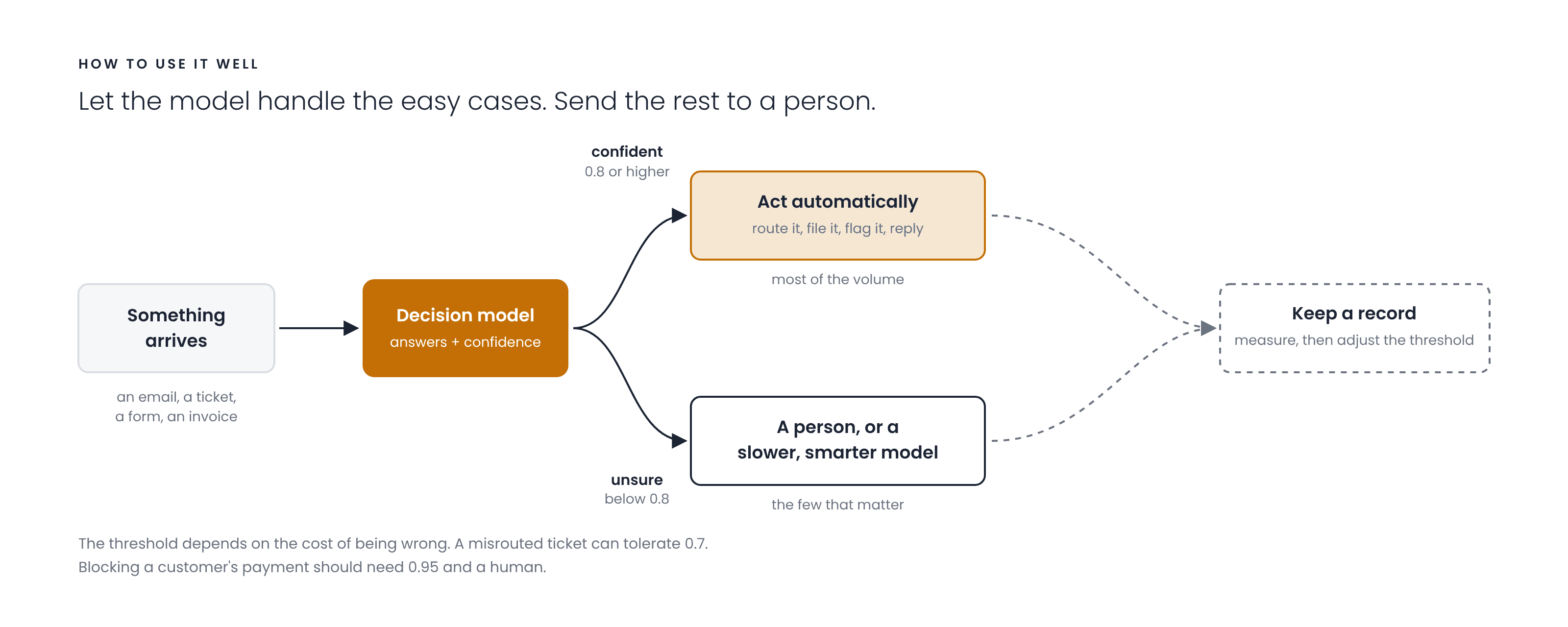
Let it handle the easy cases and send the rest to a person. Every answer comes with a confidence number, so you can set a rule: above 0.8, act automatically; below that, escalate to a person or to a slower, smarter model. In one benchmark this cascade matched a frontier language model's accuracy at about a quarter of the cost and half the time. The threshold should depend on the price of being wrong. A misrouted ticket can tolerate 0.7. Blocking a customer's payment should need 0.95 and a human.
Test it on your own data before you trust it. Run it alongside whatever you do today on a thousand decisions where you already know the right answer. At these prices that costs well under a dollar. You will learn exactly how it performs on your emails, your tickets, your invoices, instead of trusting the vendor's benchmark or ours.
None of this is new to anyone who has run an operations team. Define the decision, write down the allowed answers, decide who acts on which cases, measure before you switch. That is why we think the hard part of decision models is not the model. It is knowing which decisions you make, in what order, and what happens when the answer is wrong. Companies that already have that mapped will get value from this in weeks. Companies that do not will spend the first month discovering their own process.
What we found when we tried it
The inbox test at the top of this article is the one I ran, so here is what came back beyond the headline numbers.
Jev sorted half of the 749 emails as coming from clients or prospects, 18% as community and event messages, 15% as receipts and notifications, and 11% as partners and vendors. It flagged only 4% as junk, and 25 of those were emails Gmail's own Promotions filter had let through to my main inbox.
The sobering part was the workload. It rated roughly four out of five emails as worth a reply, about 20 a day, nearly one in five as needing attention the same day, and one in seven as involving money: an invoice, a price or a budget. Four in five is almost certainly too generous, and that is the lesson rather than a flaw. I asked "would a reply be valuable" and the model took me at my word. The threshold is mine to set, and the next run will ask a narrower question.
Just as useful, it told me when it wasn't sure. It was at least 90% confident about the type of email on 28% of messages and under 60% confident on 30%. Those uncertain ones are exactly the pile a person should look at. For a business our size, the takeaway is simple: a first pass over a whole month of email no longer needs expensive AI or an assistant. It costs pocket change and hands you the short list that needs your judgment.
Where it falls short
A fair account has to include the limits, and some of them matter a lot for the businesses we serve.
It cannot explain itself. Jev returns a number, never a reason. If you work in a regulated industry, or you need to show an auditor why a claim was flagged or a transaction was blocked, a decision model on its own is not enough. You will need a language model or a person to supply the explanation, which adds back some of the cost you saved.
It reads literally. It can miss a "not" or an implied condition. It is bad at arithmetic and date comparisons. If your software can compute something exactly, compute it in software and do not ask the model.
Vague questions get vague answers. The 62.6% phishing result above is what happens when you ask it one broad question. The work of breaking a judgment into small, specific questions is on you.
Replacing one step does not speed up the pipeline. When a TypeSafe engineer swapped a single step of a real workflow for Jev, the whole system got 15.9% faster, not 190 times faster. The headline speed numbers are per call. Your gain depends on how much of your process that call represents.
It can be wrong with confidence. "Cannot hallucinate" means it cannot invent an answer outside your list. It can still pick the wrong item on the list. That is why the threshold and the escalation path matter more than the model.
The pricing is unproven. TypeSafe says plainly that it cannot yet prove its prices are sustainable, and that it expects them to fall rather than rise. The competitors have priced to match, which suggests the floor is real, but a business case built on four cents per million tokens should survive it being forty.
One more honest note. A skeptical thread on the developer forums asked whether Jev is simply a classifier, a kind of model that has existed for years, rebranded with modern training and a good launch video. The best answer was yes and no: the idea is old, but the training, the calibration, and the fact that it generalizes to questions it has never seen are new. We find that a fair summary.
The competitive landscape
This section is for readers who want to know who else is in the market. It is accurate as of late October 2026 and will date quickly.
Jev created the category, and within three weeks every major platform had an answer.
| Model | Who | Launched | Price per million input tokens | Notes |
|---|---|---|---|---|
| Jev | TypeSafe AI | September 15 | $0.042 | The original. Closed model, hosted API, the most tooling and integrations. 64K context. |
| Decisions API | OpenAI | September 29 | $0.10 | A constrained version of GPT-6 Luna, not a new architecture. Accepts images. Limited preview at launch. |
| Clef and Clef-flash | Cloudflare | October 1 | $0.24 and $0.09 | Open weights under Apache 2.0, so you can run them yourself. Same API shape as Jev. Accepts images and video. |
| Decision-1 | Microsoft | October 9 | $0.042 | On Azure AI Foundry, priced to match Jev exactly. 32K context. Built on an open Qwen model. |
| pplx-decider | Perplexity | Late September | $0.02 | Cheapest hosted option. Open weights. Leads one independent accuracy index. |
| Strands Decider, Laya, others | AWS, Convai, community | October | Free, self-hosted | Small open models you run on your own hardware. Accuracy varies widely. |
Three things stand out. Most of the field, including Microsoft's and Cloudflare's entries, are fine-tunes of existing open models rather than new architectures. The price has already converged on a few cents per million tokens, which tells you the decision layer is becoming a commodity. And for a business choosing one, the deciding factor will usually be where you already run: Azure shops will use Decision-1, Cloudflare users will use Clef, and TypeSafe's edge is the depth of its tooling and the fact that it got there first.
There is also a priority dispute. A researcher at a small company says he published the core idea a year before Jev launched, for a sales use case, and was ignored. He has since released his own open model. We mention it because it will come up, not because it changes anything for a buyer.
What to do this month
You do not need to buy anything or write any code to get the value of this article. You need a list.
Sit down with whoever runs your operations and write down the ten decisions your team makes most often by hand. Not the big ones. The two-second ones: where does this email go, is this lead real, which bucket does this ticket belong in, does this invoice need a second look. For each one, note who makes it, how many times a day, and what it costs when it is wrong.
That list is the whole input to a decision model project. It is also, in our experience, a document most companies have never written, and the act of writing it tends to find a few things worth fixing before any AI is involved.
If you would like a second pair of eyes on that list, or you want to talk through where a decision model fits in your operation, we are happy to spend half an hour on it. Book a time.
Tony Sheehan is co-founder and CTO of NorthBound Advisory, an AI adoption consultancy based in Saint John, New Brunswick, that works with small and mid-sized businesses, scaleups and funded startups across Atlantic Canada.
Sources
- Introducing System One Models and Jev, TypeSafe AI, September 15, 2026
- A new kind of AI model from a ChatGPT inventor is thrilling developers, TechCrunch
- TypeSafe's Jev hits 35% of Vercel teams at 0.27% of spend
- Bloomberg reports TypeSafe raised $870M at a $7.5B valuation
- What is Jev? TypeSafe's decision-making AI model and real benchmarks, GreenNode (phishing test, pipeline result, cascade benchmark)
- Jev-like decision models are flooding the AI market, Tom's Hardware
- OpenAI's Decisions API vs Jev, Firecrawl
- Cloudflare Clef explained, eesel
- Microsoft Decision-1 pricing, eesel
- Decision models explained: Jev vs Clef vs Strands Decider, eesel
- The Rise of Decision Models, Mike Walsh
- Jev by TypeSafe: A New Agent Layer, If Calibration Holds, AgentConn (summary of Reddit debate)